Showing posts with label horn. Show all posts

Thursday, December 14, 2017

FrankenTurntable and Speaker Upgrades

I've been helping a friend of mine with his stereo recently and it got me energized to do some work on my own. First of all, I decided to finish a long-term project of mine that's been on hold since my daughter was born: assembling a turntable out of myriad spare parts, most of which I already had lying around.
The platter and mechanism came from a frustratingly crappy direct-drive linear-tracking turntable that I rescued from the trash. I bypassed all of the control circuitry and wired the power directly to the motor, so it only turns at 33 1/3 RPMs (i.e., no 45s for me), but it seems to be pretty solid and consistent at that, at least. I'm interested in trying some different platter materials at some point, but I doubt the motor has enough torque to handle anything much heavier than the one it came with.

The tonearm comes from a Technics SL-1950. I bought this one used off of eBay for about $50. I mounted it to some spare blocks of wood I had lying around and purchased some long, skinny nuts and bolts that I used to raise it to the appropriate height for the platter and get it leveled properly. I also used the wood to sandwich some female RCA jacks that I spliced onto the tonearm's own wires so that I could hook it up to my preamp using standard RCA cables (the yellow jack is the ground line).

It sounds really good and, despite looking ghetto af, it has a nice, post-apocalyptic DIY charm that that appeals to me. More importantly, though, this raw setup provides a direct line from the tonearm to the preamp/amplifier without any of the circuitry in the way that can lead to signal degradation in many more user-friendly turntables (like my LP-120 before I modded it for a direct connection, as well).

If you'd like to hear the output, it's the turntable I used to make the recordings for my cartridge comparison post.

Next up, I've been giving my Dared VP-20 tube amp a rest lately and am instead using a Lepai LP-2020TI tripath amplifier I purchased from Parts Express. It seems Lepai is no longer producing the original model, the LP-2020A+, which is a shame since it was so well-loved among audio enthusiasts, but they are making what is essentially a clone using a more easily sourced chipset (it pumps out a few extra watts, too, which is nice). It has the same clean, low-distortion sound as the original (as long as you keep the volume dial below about 11 o'clock, just like the original...) and, as much as I like my tube amp, the Lepai provides a clear accuracy that can be a refreshing change of pace from the folksy warmth of the tubes.

Finally, I overhauled my backloaded horns--which I originally fitted with some cheap but adequate drivers from MCM Electronics--with some really nice Tang-Band full-range drivers. Since the MCM drivers are only good to about 4 kHz, I had them set up on a 3-way crossover with some Bohlender Graebener Neo8 midranges. It sounded good, but I've always heard that full-range drivers running uncrossed sound more "realistic" than 2-/3-way setups.

So, I hooked the Tang-Bands up uncrossed with the ribbon tweeters wired in parallel (the Lepai can push the combined 4-ohm load just fine), and sure enough: they sound a lot brighter and more even than the crossed 3-way setup, likely due to the Tang-Band's hump above 15 kHz combined with the natural lack of sensitivity mismatching.

The Tang-Bands are supposed to be good down to 60 Hz, but they were barely usable down to probably 80-100 Hz or so (I suspect the chambers in my horn boxes just aren't large enough for the rated performance), so I definitely need my 15" subwoofer in the mix now (my old 3-way setup benefited from it, as well, but it wasn't strictly necessary). Likewise, the ribbon tweeters are supposed to be on high-pass filters for safety, but I'm pushing such a light load through them that I'm pretty sure they'll be okay.

Sunday, July 31, 2011

My DIY Backloaded Horn

Over the past 6 months or so, I've been researching and ultimately building a pair of backloaded horns. At the time of this writing, I've only actually finished one of them, but I decided to go ahead and make a post about it.

My Phase Technology Teatro 7.5s sound great, but they're pretty weak on the low-end. I've been supplementing with a shitty powered subwoofer scavenged from a boxed 5.1 surround system, but it just doesn't cut it, unfortunately, so I decided to build some speakers that would cover it a little better.

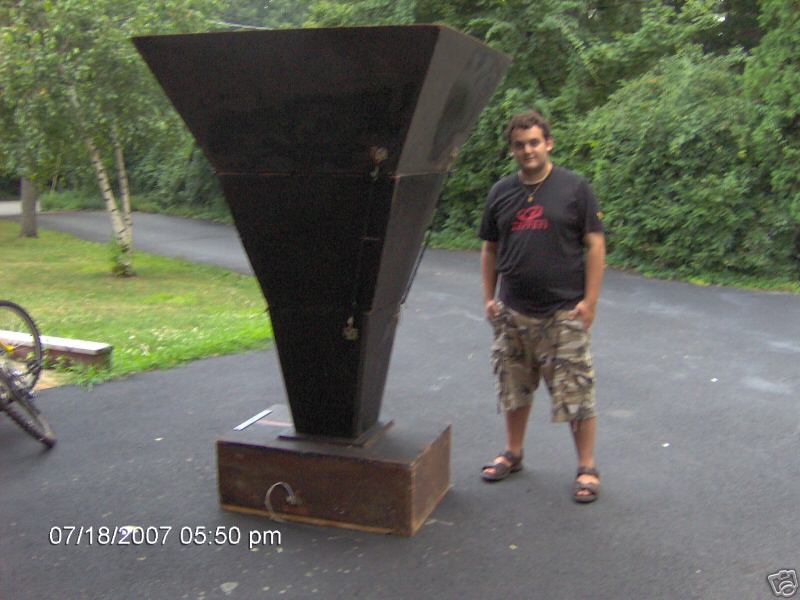
Since getting my upper-mid horns and hearing their clarity and definition, I wanted to go with another horn for the bass, if possible. I've seen a lot of really crazy, gigantic basshorns on the internet and wanted to avoid the size that would be required to reach below 100 Hz with a compression driver--not to mention the batshit crazy prices that large-scale compression drivers go for on eBay and Audiogon--so I decided to look into backloaded horns.

Ideally, a horn should be as long as the wavelength of the lowest frequency you wish to reproduce, with a mouth of approximately that same diameter, thus bass horns have to be gigantic to reach low frequencies. You can cheat a little, though, by placing the horn against the floor and/or wall of your room, which lets you cut the wavelength requirement by half for each surface, as it uses the walls/floor as if they were a part of the horn. Furthermore, backloaded horns are typically folded horns, which lets them squeeze a lot of length into a relatively small package. Finally, by starting with a large cone driver, your required horn length is reduced further still.

I used this 8" driver for the horns, based on their high sensitivity, though these would also be an excellent alternative. If you don't plan to supplement the horns with a tweeter like I intend to do, you might also consider using a full-range driver, like this one, though it is obviously more expensive. This driver is another good option if you want to play at high volumes, due to its high power handling and *huge* cone excursion.

I came up with my own design for the horn itself, based loosely on some designs I found around online. However, most of the designs I found have the mouth of the horn opening into the wall, which I was afraid would deaden the sound, based on how directive my upper mid horns are. So, I tweaked those designs a bit and ended up with something I could construct out of a single sheet of 4'x8' of wood (MDF [medium-density fiberboard] is the best for speakers, but it's heavy, expensive and rough on your tools; particleboard is a good compromise, IMO, insofar as it is very cheap, but with many of the same characteristics as the more expensive MDF; plywood works, too, but it's ugly).

I used 1/2" particleboard, though TBH, 3/4" would probably have been a better choice, both for rigidity and sound isolation. The sides are 2'x4', the back is 1'x4' and everything else is 1'x2' (i.e., the front, the top/bottom and the interior partitions; the last piece is cut in half and glued together at a right angle). I'm not going to go into much detail about the actual construction, since I'm a shitty carpenter and I'm sure you can find better instructions on box-making online than I could ever provide. Anyway...
Glue the pieces together using wood glue, and don't be afraid to really gob it on. You want it to seep into all of those little nooks and crannies in the wood and form a good seal. You can see the excess squeezing out from under the board in this pic:
To be sure that the junctions are all airtight and won't be leaking air into each adjacent chambers, you can follow behind with silicone caulk or "liquid nails" formulated for wood, which is what I used:
If you look closely, you can also see the right-angle brackets I used to reinforce the box structure.
After all of the interior structure is glued solidly into place, you can glue the other side panel to seal the cabinet shut. I used the liquid nails instead of wood glue to seal it, with a bunch of cinder blocks, books, records, etc. piled on top to get a good connection while the goo dries:
One thing to remember before sealing the cabinet: go ahead and thread some speaker wire through because it'll be much easier now than if you wait. If you do forget (like I did, actually), you can tie the wire around something (I used my dog's Kong toy), drop it into the speaker hole and then flip the whole thing around until it pops out the mouth of the horn. This is harder than it sounds, though, because these horns are gigantic and heavy as shit.

Another bit of advice, do your painting *after* your gluing (unlike me), so you don't have to worry about excess glue spilling over onto your fancy paint job.

Most of the projects I've seen online make a big deal about filling any cavities with sand or kitty litter so they don't turn into resonance chambers, but I don't really notice any problems and I did not do it. Of course, YMMV.

Anyway, here's the finished product:
You can see my small upper mid horn perched on top. You can also see the speaker wire dangling out of the mouth of the horn, since I haven't purchased proper binding posts yet (maybe never...).

As far as the sound, the bass response is considerably more potent than I expected. The driver works as a direct radiator (so better quality drivers will make a noticeable difference in sound quality), while the low frequencies bounce around inside and bellow out of the horn's mouth. The horn produces some of the clearest, most defined bass I've ever encountered, though it is definitely lacking above 1 kHz. That in mind, I intend to pair it with either this tweeter or this one.

One last picture of the finished horn, this time from the side:
The depth is really what makes these guys huge. Special thanks to my wife, who is gracious and long-suffering :-P

Friday, March 18, 2011

My First Mid-horns for Hifi

I've spent a lot of time on audiophile forums reading about the advantages of horns over purely cone-based speakers, including crisp sound reproduction, consistency, "realism" and extremely high sensitivity. The drawbacks, of course, being high cost (sometimes ridiculously so), a dearth of non-vintage models to choose from, few places to demo products before buying and, perhaps most importantly, the tremendous size requirements for horns that will reach lower frequencies. Horns are also known for their "honkiness" and directivity, which can be a problem if you often listen to music outside of your stereo's "sweet spot."

While any driver can be horn-loaded, when people talk about horns, they usually mean a compression driver with a horn attached to the front, either through bolting (the standard for audiophile equipment) or via a threaded, screw-on junction (the standard for professional equipment). Relative to normal drivers, compression drivers have very low distortion due to the small size of the membrane and the relatively short distance the membrane needs to travel.

So, as I began looking into mid-horns, most of the information available online suggests that you will need to purchase vintage equipment, such as 1950s-era JBL compression drivers and similarly aged JBL or Altec Lansing horns or else build your own horns, which can be a daunting task to say the least. If you go on eBay and look for these products, you'll see that very little is available for less than $1,000, as they have reached the status of collectors' items and are priced as such.

However, I also noticed that horns and compression drivers are still used quite extensively in professional audio settings, such as stage monitors and PA speakers. In fact, Selenium's D250-X compression driver has performance specs that looked very similar to those of the multi-thousand-dollar, vintage compression drivers I was seeing on eBay, including an uncrossed frequency response from 400 Hz to approximately 9 kHz and a sensitivity of 107 db at 1w/1m, but with a power handling capability of 150w (vs. very low power handling on vintage equipment). The biggest difference, though, is the price: ~$35!

These MCM drivers are also a good, cheap option, with a low frequency range down to 100 Hz!

Likewise, when looking into mid-horns, the prices for newly constructed or high-quality vintage equipment usually range from ~$750+ up to tens of thousands of dollars. This is simply too expensive for me, so I began looking for other options, including DIY solutions and professional audio. At this point, I had to make some decisions, including which horn curve I wanted to use.

Deciding on horn curves is basically a matter of weighing a series of compromises and figuring out what matters to you most/least. While conical horns tend to have the least honky horn coloring and are also easy to construct, owing to their straight-angled sides, they are also the least space-friendly and also tend to be very ugly, in my opinion. Exponential horns take up considerably less space than conical horns for a given frequency response, but they are more difficult to construct, due to their curved sides. Similarly, square/rectangular horns tend to have better dispersion and listening angles than round horns, while round horns impart less distortion to the sound wave.

I decided that a round exponential, while difficult to construct, would be my best bet, since I want to experience the horn sound and my space is limited (my listening room is less than 200 sq feet).

While weighing my options, I came across some potentially good options in the pro realm, including the Dayton Audio H12RW 12" waveguide and the Selenium HL14-25 exponential horn. The waveguide was attractive to me because it can easily drop right into an existing speaker cabinet designed to house a 12" woofer. However, waveguides are a little different from traditional horns, and that's really what I wanted to try. That in mind, I went with the HL14-25 horns, which have a suggested frequency range from approximately 600 Hz to 5 kHz, well inside the range of the driver.

When I received the horns, I first tested them by wiring them in series with my Phase Technology Teatro 7.5s (8 ohm, 90 db sensitivity, freq. resp. of 40 Hz to 20 kHz), but the sensitivity of the horns was too far off from that of the Teatros, such that the horns were ear-splittingly loud by the time the volume was high enough to hear the Teatros comfortably. With that in mind, I resurrected my old Sony solid state receiver (100w per channel) and wired it to push the Teatros and my subwoofer while my Dared VP-20 pushed the Selenium horns. This way, I could independently adjust the volumes to achieve a good balance between the horns and the Teatros, and then use my preamp's volume control as a sort of 'master volume.'

To run my initial tests, I left the horns uncrossed and expected a good bit of distortion below the 400 Hz mark, since that's as low as the drivers are supposed to go. I cautiously kept the volume very low as I didn't wish to blow my new drivers on their first go 'round. However, I was pleasantly surprised to find that the horns handled the lower frequencies quite gracefully, with no distortion that I could notice--even when playing as loud as I could comfortably stand--and with a fairly smooth (though rapid) rolloff below around 600 Hz. I'm assuming this success is largely due to the fact that the horns are probably receiving only a handful of watts instead of the 100+ watts that are normally shoved through them in professional applications.

Based on this experience, I have decided not to bother with a crossover at this time, though I may revisit the issue in the future.

I guess the real question now is: "How does it sound?" In short, it sounds fantastic. The frequency range covered by the horns encompasses guitar solos, most vocals and organs, which all sounded a bit anemic on my Teatros alone. The clarity and definition in these frequencies is truly astounding and must be experienced. If you've only ever heard cone drivers for this range (like me before I bought these horns), it's honestly impossible to imagine how rich the sound reproduction can truly be.

My setup is designed to allow for extensive A/B testing (in addition to the independent volume control for the Teatros and horns, the VP-20 has independent volume control for each channel), and this is where the improvements really shine. Even my wife (who is very honest about differences she can and can't hear, often to my chagrin) was blown away by the disparity between Teatro+horn vs. Teatro alone.

The horns admittedly have some strong directivity, but they also have a good--though different--sound off-axis, such that listening outside of the sweet spot is still nice, just not the same as getting right there in the middle.

Here are a couple of pictures of the horns sitting on top of my Teatros:

In the first picture, you can see the VP-20 that pushes them, as well a little bit of my disc changer, preamp and crummy solid state amplifier.

Analytics Tracking Footer